The Market-place
Thus Spoke ZarathustraThe Market-place is the public setting against which Zarathustra measures the failure of speaking to everyone and the difficulty of addressing the Higher Men. It is less a described physical place than a social arena: the mob gathers there around a shared belief in equality, while persuasive speech depends on gestures rather than reasons. Its decisive significance lies in the contrast between public address and understanding. A speaker may reach the whole crowd without reaching anyone, and even a truth that prevails there remains shadowed by the error that helped it triumph.
A Public Place and a Failed Address
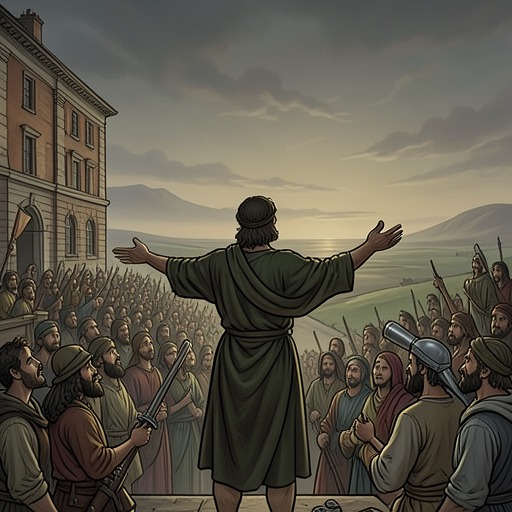
Zarathustra recalls that when he first went among people, he made what he calls the great folly of hermits: he set himself in the Market-place. The mistake was not simply going among people; it was expecting a public audience to answer the needs of his speech. He spoke to everyone, yet spoke to no one. The Market-place thus gives physical form to a failure of communication: broad exposure does not produce attention, recognition, or understanding.
The recollection sharpens this failure through its contrast with evening. After the public day, Zarathustra found himself among tight-rope walkers and corpses, and describes himself as almost a corpse. The Market-place is not given a detailed landscape or a record of its ordinary business. Instead, its meaning emerges from the change of company and state: public speech leaves him isolated, while the evening’s companions belong to the danger and death that had marked his first encounter with the crowd. With the new morning, a new truth comes to him, and he turns from the question of how to address everyone toward the question of what the Market-place and its mob can receive.
The Mob, Equality, and the Death of God
In addressing the Higher Men, Zarathustra warns that no one in the Market-place believes in Higher Men. If they speak there, the mob responds by blinking and insisting that all are equal. Its claim is not merely a judgment about social rank: the crowd grounds it in equality before God, declaring that humanity is simply humanity before the divine. The Market-place therefore becomes the scene in which a collective conviction answers and neutralizes the distinction Zarathustra wants his listeners to recognize.
Zarathustra’s reply turns on the death of God. The mob still invokes equality before God, but the authority supporting that formula has, he says, disappeared. This does not lead him to ask the Higher Men to establish equality before the crowd on some new basis. Instead, he warns them not to be equal before the mob and urges them to leave the Market-place. The passage places two claims side by side: the crowd’s inherited religious formula and Zarathustra’s insistence that the conditions which once gave it force have changed. The public setting is where that change becomes a conflict over who may define human worth and equality.
Reasons, Gestures, and Public Persuasion
A later warning gives the Market-place a more specific account of how its public opinion operates. The Higher Men are told to keep their reasons secret, because the present belongs to the mob. Zarathustra asks who could overturn with reasons what the mob has learned to believe without reasons. The contrast is between a belief acquired without rational argument and an attempt to unsettle it by argument; the latter cannot assume that the former will answer on the same terms.
In the Market-place, Zarathustra says, gestures convince, while reasons make the mob mistrustful. This observation explains why the location is hostile not simply to a particular speaker but to a particular mode of persuasion. Public influence depends on visible acts and the crowd’s response to them, whereas explicit reasoning risks arousing suspicion. The advice to conceal reasons is therefore a response to the place’s stated persuasive conditions, not a claim that reasons have no value in every setting. The Market-place rewards a form of public performance that the Higher Men are warned against mistaking for genuine understanding.
Truth and the Error Behind Its Victory
Even the triumph of truth does not settle the Market-place’s meaning. Zarathustra says that when truth has prevailed there, the Higher Men have asked, with healthy mistrust, what mighty error fought for it. Victory is thus not proof that the crowd has abandoned its habits of belief or that the result rests on sound reasons. A truth can win within a public contest and still owe its success to an error powerful enough to fight on its behalf.
This ending extends the passage’s earlier contrast between speaking to everyone and speaking to no one. The Market-place can produce agreement, persuasion, and even the apparent victory of truth, but none of these outcomes guarantees understanding. Its crowd is defined by both its attachment to equality and its susceptibility to gesture; its victories remain open to suspicion about the forces that carried them. As a result, the Market-place serves as Zarathustra’s warning about public address: the Higher Men must recognize the difference between a message being heard, a belief being shared, and a truth being understood.